
ISSN: 2369-0674
Table of Contents
- Message from the Chair
- Introduction
- About the Veterans Review and Appeal Board
- Organizational Structure
- Delegation Order
- Performance for 2025-2026
- Summary of key issues and actions taken on complaints
- Extensions
- Consultations
- Training and Awareness
- Proactive publication under Part 2 of the Access to Information Act
- Annex A: 2025 Delegation Order on the Access to Information Act and Privacy Act
- Annex B: Statistical reports on the Access to Information Act
- Annex C: Supplemental statistical report on the Access to information Act and Privacy Act
Message From the Chair

On behalf of the Veterans Review and Appeal Board (VRAB, the Board), I am pleased to present the 2025-2026 Annual Report to Parliament on the Administration of the Access to Information Act.
This legislation enhances government transparency by allowing Canadian citizens to access information held by the Government of Canada. It promotes openness, accountability, and dialogue between citizens and their government.
The Board continues to strengthen privacy and access to information practices to ensure Canadians can exercise their right of access to government records, receive high-quality information without delay, and have confidence that their personal information is protected.
Over the past year, the Board’s Access to Information and Privacy (ATIP) unit continued work to advance privacy and access to information practices. Through improved governance, stronger collaboration, and modernized processes, the unit worked to protect personal information, support government transparency, and improve the efficiency and consistency of services provided to the public.
In the 2025-2026 fiscal year, the Board's ATIP unit processed 27,163 pages in response to ATIP requests and met its legislated timelines 98% of the time, ensuring Canadians received timely access to information.
I invite you to explore the report to learn more about our work.
Sincerely,

Richard Thibault
Acting Chairperson
Introduction
The Access to Information Act is intended to promote transparency by providing Canadian citizens and individuals present in Canada with a broad right of access to government records, while recognizing certain limited exceptions necessary to protect other important interests. It maintains that government information should be available to the public and should complement and not replace existing procedures for access to government information.
Section 94 of the Access to Information Act requires that the head of every government institution prepare a report on the administration of the Act for submission to Parliament each fiscal year.
This Annual Report is prepared and tabled in Parliament in accordance with Section 20 of the Service Fees Act.
About the Veterans Review and Appeal Board
The Veterans Review and Appeal Board has full and exclusive jurisdiction to hear, determine and deal with all applications for review and appeal that may be made to the Board under the Pension Act, the Veterans Well-being Act - Part 3, the War Veterans Allowance Act and other Acts of Parliament. All matters related to appeals under this legislation are authorized under the Veterans Review and Appeal Board Act.
The Board also adjudicates applications for review and appeal of service-related disability benefits decisions under the authority of the Royal Canadian Mounted Police Pension Continuation Act and the Royal Canadian Mounted Police Superannuation Act.
The Board follows the open court principle. This means that hearings and decisions are open to the public.
The Board's decisions are published on the Canadian Legal Information Institute (CanLII) website. CanLII is a well-known legal resource that organizes decisions by year and is searchable by key word.
To balance openness in decision-making while maintaining an applicant’s privacy, the Board removes personal information that is not relevant to the decision. This includes names of the applicant and non-expert witnesses, as well as other information that could identify the individual (e.g. file numbers or home address). A published decision may contain some information that is relevant to the decision, such as:
- the relationship between the applicant/appellant and a family member or witness at the hearing;
- medical conditions;
- occupational information;
- personal characteristics that are relevant to the disability application; and
- excerpts of medical opinions and doctors' reports.
This approach is consistent with the principles found in the "Use of Personal Information in Judgments and Recommended Protocol" approved by the Canadian Judicial Council.
Organizational Structure
The Board has full responsibility for the administration of the Access to Information Act and the Privacy Act. The ATIP unit is under the Director, Strategic and Corporate Services, who acts on behalf of the Chair of the Board to oversee the administration of the Access to Information Act and the Privacy Act.

Responsibilities of the ATIP unit:
- Process requests for information submitted under the Access to Information Act and the Privacy Act in accordance with the legislation, regulations, and Treasury Board of Canada Secretariat (TBS) policies, guidelines and directives.
- Provide Board management and staff with advice and guidance regarding the interpretation and application of the Access to Information Act and the Privacy Act and related TBS policies, guidelines and directives.
- Develop policies, procedures and guidelines for the administration of the Act and related TBS policies, guidelines and directives.
- Coordinate the resolution of any complaints against the Board made to the Information Commissioner under the Access to Information Act and the Privacy Act.
- Respond to consultations from other government institutions on access and privacy requests.
- Promote awareness to ensure employees understand their roles and responsibilities and the Board fulfills its obligations under the Acts.
- Respond to Parliamentary Written Questions on access to information and privacy breaches.
- Support the Board’s commitment to openness and transparency through proactive disclosures, informal releases of information and publishing the summaries of completed access to information requests to the Open Government portal.
- Review contracts with third parties using TBS guidance documents.
- Update the Board’s information regarding the Info Source chapter on the Board’s website in accordance with the TBS directive.
- Monitor and report on the Board’s proactive disclosures.
- Prepare the annual reports to Parliament and the Annual Statistical Report on the administration of the Access to Information Act and the Privacy Act.
Delegation Order
In September 2025, the Chairperson of the Veterans Review and Appeal Board delegated his authority for the purposes of the Act. Annex A is a copy of the signed delegation instrument that took effect September 1, 2025.
Performance for 2025-2026
In the 2025-2026 fiscal year, the Board’s performance in responding to requests for information under the Access to Information Act has been marked by notable efficiency and transparency. The period saw a significant increase in the number of requests received with a decrease in pages processed from the previous year.
Formal access to information requests
The statistical reports support oversight, accountability, and transparency by providing data on the performance of the Government of Canada’s Access to Information program. The following section provides a summary of the highlights of the Statistical Report (Annex B) regarding the Administration of the Access to Information Act for the period of April 1, 2025, to March 31, 2026.
In the 2025-2026 fiscal year, the Board responded to seven Access to Information (ATI) requests, and was within the legislated timelines 100% of the time – a key measure of the Board’s performance.
| 2021-2022 | 2022-2023 | 2023-2024 | 2024-2025 | 2025-2026 |
|---|---|---|---|---|
| 6 | 3 | 4 | 3 | 7 |
A total of seven requests were completed during the reporting period. Of those requests, 86% requests were completed within 15 days, while 14% were completed within 16 to 30 days. No requests took longer than 30 days to complete.
By disposition:
- Two requests were disclosed in their entirety, with one completed within 15 days and one within 16 to 30 days.
- One request was disclosed in part, completed within 15 days.
- One request resulted in no records existing, completed within 15 days.
- One request was abandoned, completed within 15 days.
- Two requests were neither confirmed nor denied, both completed within 15 days.
- There were no requests that were all exempted, all excluded, transferred, or declined with the approval of the Information Commissioner.
- One request remained open at fiscal year-end and was carried forward to the next fiscal year; however, it remained within the legislated timelines for processing.
There were no active requests as of the last day of the reporting period.
Figure 1. Number of pages processed vs the number of pages release by fiscal year
Figure 1. Number of pages processed vs the number of pages released by fiscal year 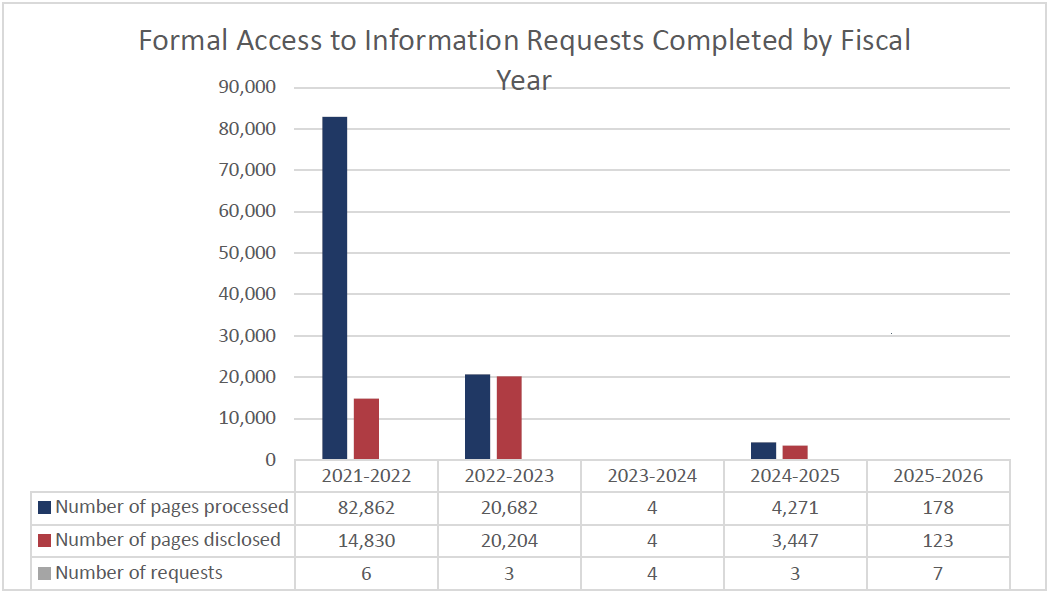
For 2025-2026, a total of seven requests were completed, involving 178 pages processed and 123 pages disclosed. While the number of requests was higher than in previous years, the volume of records processed was comparatively low.
The data reflects the unique workload dynamics of the Board's ATIP program. Request volumes alone do not necessarily indicate the level of effort required, as the number of records and their complexity can vary substantially between requests. Throughout these fluctuations, the Board's ATIP unit has remained agile and responsive, effectively managing changing demands while meeting all statutory requirements.
Informal access to information requests
The Access to Information Act mandates that Canadian government institutions publish summaries of the access to information requests they handle. Individuals can make informal requests for information previously disclosed under this Act, without incurring charges or adhering to specific timelines.
In 2025-2026, the Board received 12 informal access to information requests, resulting in the release of 11,888 pages. All requests were completed within 0-15 days.
There were no active requests as of the last day of the reporting period.
Summary of key issues and actions taken on complaints
The Access to Information Act grants individuals the right to access information held by government institutions. It also allows individuals to file a complaint with the Information Commissioner regarding issues related to an access request made under the Act, such as:
- the institution’s response to the request
- the institution’s failure to respond to the request
- the manner in which the institution handled the request.
In 2025-2026, the Board did not receive any complaints regarding access to information requests. No issues were raised by individuals concerning the handling or response to their requests. The Board remains committed to maintaining transparency and ensuring that all access to information requests are managed efficiently and effectively.
Extensions
Section 9 of the Access to Information Act allows institutions to extend the original 30-day statutory time limit if:
- the request is for a large number of records and meeting the original time limit would unreasonably interfere with the Board’s operations.
- consultations are necessary.
- third-party notification is required under subsection 27(1).
There were no extensions applied during the 2025-2026 fiscal year.
Consultations
Consultations with other government institutions take place when records that originate from another institution are retrieved in response to an ATIP request. Consultations are conducted if the disclosure of another institution’s information could cause harm to that institution, compromise the conduct of international affairs, interfere with an investigation, affect national defence or involve other factors.
In 2025-2026, the Board received one consultation request from another Government of Canada institution. A total of 1,125 pages were reviewed. The Board recommended full disclosure of the information. A response was provided within 15 days for the request
Training and Awareness
In 2025-2026, the Board’s ATIP and Information Management (IM) units worked together to strengthen ATIP training for VRAB staff and Members.
Onboarding of new staff
As part of the onboarding process, many of our new employees and students at the Board participated in a newly developed ATIP training session. The session provided a comprehensive overview of personal information and information of business value, while reinforcing the important role employees play in information management and compliance with legislative requirements. It also highlighted best practices for handling information of business value and outlined measures to help prevent privacy breaches.
During the 2025-2026 fiscal year, the Information Management unit facilitated targeted small-group sessions with Board employees on information management processes and the transition to SharePoint. Approximately 35 employees (representing 100% of new staff) received role-specific training tailored to their business activities and information-handling needs.
Broader organization-wide training was also delivered to provide employees with general guidance on using SharePoint, managing documents and applying consistent information management practices. These sessions supported the ATIP program by promoting consistent recordkeeping practices, improving the organization and retrieval of information, and helping employees store sensitive information in appropriate locations with suitable access controls.
The training that was provided to students working on the hearing recording digitization project covered proper handling and transportation of client records, disposition protocols of physical media once digitized, and the handling of client information in electronic client systems. Once completed, all students transitioned to the Physical Records Digitization Project. This project converts paper records (both corporate and client records) into secure electronic formats to improve accessibility, preservation and retrieval. It also reduces reliance on physical storage and supports more efficient searches for records responsive to ATIP requests.
Training and Awareness
Training and awareness activities related to the Access to Information Act were supported through ongoing guidance and day-to-day engagement with Board employees. The ATIP unit provided advice on access to information requirements, roles and responsibilities, and the handling of records as part of its regular operations. This continuous support helped foster awareness of access to information obligations and promoted compliance with legislative requirements across the organization.
Policies, guidelines, and procedures
The Board's ATIP unit continued to support managers and program areas by providing timely advice and guidance on policies, guidelines and procedures. Through ongoing consultation and collaboration, the unit helped ensure consistent application of requirements, strengthened compliance practices, and supported informed decision-making across the organization.
Proactive publication under Part 2 of the Access to Information Act
Proactive publication under Part 2 of the Access to Information Act requires federal institutions to automatically publish certain types of information without waiting for specific requests. This includes materials like travel expenses, reclassification of positions and contracts over $10,000. The goal is to enhance transparency and accountability by making government information readily accessible to the public.
The table below outlines the Board’s proactive publication requirements and the percentage of time these requirements were met for 2025-2026.
| Legislative Requirement | Section of ATIA | Publication Timeline | Does requirement apply to your instituion? (Y/N) | Internal group(s) or positions(s) responsible for fulfilling requirement | % of proactive publication requirements published within legislated timelines* | Link to web page where published ** |
|---|---|---|---|---|---|---|
| All Government Institutions as defined in section 3 of the Access to Information Act | ||||||
| Travel expenses | 82 | Within 30 days after the end of the month of reimbursement | Y | Administrative Services | 100 | Government Travel Expenses |
| Hospitality Expenses | 83 | Within 30 days after the end of the month of reimbursement | Y | Administrative Services | 92 | Hospitality Expenses |
| Reports tabled in Parliament | 84 | Within 30 days after tabling | Y | Strategic Planning and Corporate Services | 100 | Open Government Portal |
| Apply to government entities or Departments, agencies, and other bodies subject to the Act and listed in Schedules I, I.1, or II of the Financial Administration Act | ||||||
| Contracts over $10,000 | 86 | Q1-3: Within 30 days after the quarter Q4: Within 60 days after the quarter | Y | Administrative Services | 45 | Serach Government Contracts over $10,000 |
| Grants & Contributions over $25,000 | 87 | Within 30 days after the quarter | Y | Administrative Services | 100 | Grants and Contributions |
| Packages of briefing materials prepared for new or incoming deputy heads or equivalent | 88(a) | Within 120 days after appointment | Y | Communications Division | 100 | Open Government Portal |
| Titles and reference numbers of memoranda prepared for a deputy head or equivalent, that is received by their office | 88(b) | Within 30 days after the end of the month received | Y | Office of the Chair | N/A | Briefing Note Titles and Numbers |
| Packages of briefing materials prepared for a deputy head or equivalent’s appearance before a committee of Parliament | 88(c) | within 120 days after appearance | Y | Office of the Chair | N/A | Open Government Portal |
| Applies to government institutions that are departments named in Schedule I to the Financial Administration Act or portions of the core public administration named in Schedule IV to that Act (i.e. government institutions for which Treasury Board is the employer) | ||||||
| Reclassification of positions | 85 | Within 120 days after the quarter | Y | Administrative Services | 100 | Position Reclassification |
| Apply to Ministers’ Offices (therefore apply to any institution that performs proactive publication on behalf of a Minister’s Office) | ||||||
| Packages of briefing materials prepared by a government institution for new or incoming ministers | 74(a) | Within 120 days after appointment | Y | Communications Division | N/A | Open Government Portal |
| Titles and reference numbers of memoranda prepared by a government institution for the minister, that is received by their office | 74(b) | Within 30 days after the end of the month received | N | Office of the CHair | N/A | |
| Package of question period notes prepared by a government institution for the minister and in use on the last sitting day of the House of Commons in June and December | 74(c) | Within 30 days after last sitting day of the House of Common in June and December | Y | Communications Division | N/A | Question Period Notes |
| Packages of briefing materials prepared by a government institution for a minister’s appearance before a committee of Parliament | 74(d) | Within 120 days after appearance | Y | Office of the Chair | N/A | Open Government Portal |
| Travel Expenses | 75 | Within 30 days after the end of the month of reimbursement | N | N/A | ||
| Hospitality Expenses | 76 | Within 30 days after the end of the month of reimbursement | N | N/A | ||
| Contracts over $10,000 | 77 | Q1-3: Within 30 days after the quarter Q4: Within 60 days after the quarter | N | N/A | ||
| Ministers’ Offices Expenses *Note: This consolidated report is currently published by TBS on behalf of all institutions | 78 | Within 120 days after the fiscal year | N | N/A | ||
Throughout the 2025-2026 fiscal year, the Board maintained its proactive disclosure program through established processes, regular monitoring, and monthly reporting to senior management and the Office of the Chair. These measures have supported the consistent fulfillment of legislative obligations and the timely publication of information. Building on this success, the Board will continue to learn from its experience, monitor outcomes, and make adjustments as necessary to ensure its proactive disclosure practices remain effective, efficient, and responsive to changing operational requirements. Initiatives and projects to improve access to information.
In today’s digital age, access to information is essential. The Board is working on key projects that use innovation to protect and manage information, improve access to justice, boost productivity and foster an inclusive culture that empowers staff to support all Veterans.
We strive to be open and transparent as an organization so that Veterans and Canadians can hold the Board accountable for its actions and decisions.
Digitization of hearing recordings
The digitization of hearing recordings allows for enhanced access to historical hearing recordings. It ensures the preservation of the information and streamlines the record retrieval process by reducing the time and effort needed to access recordings.
The digitization of hearing recordings on cassette tapes began in March 2023 with over 115,700 cassettes that needed to be digitized.
From April 1, 2025, to March 31, 2026, 25 students that were hired through the Federal Student Work Experience Program (FSWEP) worked on the cassette digitization project. During that time, their team processed over 74,200 cassettes on top of the more than 47,100 cassettes processed the year prior. This resulted in nearly 121,400 cassettes digitized at the completion of the project.
Following the cassette project, some of these students transitioned to work on the Physical Records Digitization project.
Physical Records Digitization project
The Board began uploading historical client files and physical records via digital imaging to client files within the Client Service Delivery Network (CSDN). This work creates a more accessible, centralized and defensible source of client information.
The initiative supports the ATIP program by improving the completeness and reliability of client records, reducing reliance on physical files, and enabling more efficient searches and retrieval of information responsive to requests
Modernization of hearing recording process
During the 2025-2026 fiscal year, the Board completed the transition from legacy handheld recording devices to a digital-first, MS Teams recording process. The new approach improves storage security, accessibility and retrieval of hearing recordings. It also reduces the risk of data loss or unauthorized disclosure and supports more timely responses to ATIP requests.
In addition, the Board is exploring further enhancements, including automated transcription, to improve searchability, accessibility and operational efficiency.
SharePoint
The Board continued preparations to transition information from shared network drives to SharePoint. This work included reviewing information holdings, identifying access requirements and assessing the sensitivity of records before migration.
The transition also required the Board to revamp its retention and disposition schedule to reflect the significant differences between the two information environments. The updated schedule will support more consistent classification, retention and timely disposition of records.
Together, these initiatives support the ATIP program by improving the organization, accessibility and lifecycle management of information, facilitating searches for responsive records, and helping ensure that personal and sensitive information is appropriately protected.
ATIPXpress
During the 2025-2026 reporting period, the Board continued to leverage ATIPXpress as its primary case management solution for administering access to information and privacy requests. The system supports the end-to-end management of ATIP files, including request intake, workflow management, records processing, deadline monitoring, reporting and case tracking.
Over the past year, the Board’s ATIP unit focused on maximizing the benefits of the platform by refining business processes, enhancing data quality, and leveraging system functionality to support efficient and consistent request processing. The system has contributed to improved oversight of caseloads, streamlined workflow management, and strengthened the Board's ability to monitor performance and meet statutory obligations.
The unit continues to work with system administrators and stakeholders to identify opportunities for enhancements and ensure the platform remains responsive to operational and reporting requirements. Ongoing improvements will support the effective management of the Board's ATIP program and the delivery of high-quality service to Canadians.
Monitoring and compliance
The Board's ATIP unit actively monitors and manages access to information and privacy requests throughout their lifecycle to support timely processing and compliance with legislative requirements. Ongoing oversight of workload, deadlines and case progress helps ensure requests are administered efficiently and effectively.
To support effective oversight and decision-making, the ATIP unit prepares monthly reports for senior management and the office of the Chair. One report provides a snapshot of current operational activities, including requests received, pages processed and pages released during the fiscal year to date. A second report presents workload and performance trends over a five-year period, enabling analysis of changes in request volumes, complexity and processing demands.
The reports also highlight emerging issues, risks, and operational pressures, such as shifts in workload, competing priorities, or resource considerations. This reporting framework supports informed decision-making, facilitates proactive workload management, and helps ensure the ATIP program remains responsive to evolving organizational needs.
Annex A: 2025 Delegation Order on the Access to Information Act and Privacy Act
The Chair of the Veterans Review and Appeal Board, pursuant to Section 73 of the Access to Information Act and Section 73 of the Privacy Act, hereby designates the persons holding the positions set out in the schedule hereto, or the persons occupying on an acting basis those positions, to exercise the powers, duties and functions of the Chair as the head of the Veterans Review and Appeal Board, under the provisions of the Act and related regulations set out in the schedule opposite each position. This designation replaces all previous delegation orders.
| Position | Access to Information Act and Regulations | Privacy Act and Regulations |
|---|---|---|
| Director General | Full authority | Full authority |
| ATIP Coordinator | Full authority | Full authority |
| ATIP Deputy Coordinator | Full authority | Full authority |
| Senior ATIP Officer | Sections of the Act: 4(2.1), 7(a), 7(b), 8(1), 9, 11(2)(3)(4)(5)(6), 12(2)(b),12(3)(b), 13, 16, 17, 19, 20, 21, 22, 22.1, 23, 24, 25, 26. Sections of the Regulations: 6(1), 7(2), 7(3) | Sections of the Act: 14(a), 14(b), 15, 17(2)(b), 17(3)(b), 18(2), 19, 22, 23, 24, 25, 26, 27, 28. Sections of the Regulations: 9, 11(2), 11(4) |
Dated, at the City of Charlottetown, this first day of September, 2025.
Christopher J. McNeil
Chairperson, Veterans Review and Appeal Board
Annex B: Statistical reports on the Access to Information Act
TBS/SCT 350-63
Name of institution:
Veterans Review and Appeal Board
Reporting period
From: 2025/04/01
To: 2026/03/01
Section 1: Requests under the Access to Information Act
| Number of requests | ||
|---|---|---|
| Received during reporting period | 8 | |
| Outstanding from previous reporting periods | 0 | |
Outstanding from previous reporting period | 0 | |
Outstanding from more than one reporting period | 0 | |
| Total | 8 | |
| Closed during reporting period | 7 | |
| Carried over to next reporting period | 1 | |
Carried over within legislated timeline | 1 | |
Carried over beyond legislated timeline | 0 | |
| Source | Number of Requests |
|---|---|
| Media | 0 |
| Academia | 0 |
| Business (Private Sector) | 1 |
| Organization | 1 |
| Public | 6 |
| Decline to identify | 0 |
| Total | 8 |
| Source | Number of Requests |
|---|---|
| Online | 8 |
| 0 | |
| 0 | |
| In Person | 0 |
| Phone | 0 |
| Fax | 0 |
| Total | 8 |
Section 2: Informal requests
| Number of requests | ||
|---|---|---|
| Received during reporting period | 12 | |
| Outstanding from previous reporting periods | 0 | |
Outstanding from previous reporting period | 0 | |
Outstanding from more than one reporting period | 0 | |
| Total | 12 | |
| Closed during reporting period | 12 | |
| Carried over to next reporting period | 0 | |
| Completion time | |||||||
|---|---|---|---|---|---|---|---|
| 0 to 15 days | 16 to 30 days | 31 to 60 days | 61 to 120 days | 121 to 180 days | 181 to 365 days | More than 365 days | Total |
| 12 | 0 | 0 | 0 | 0 | 0 | 0 | 12 |
| Less Than 500 Pages Released and Re-released | 500-10000 Pages Released and Re-released | More Than 10000 Pages Released and Re-released | |||
|---|---|---|---|---|---|
| Number of requests | Number of pages | Number of requests | Number of pages | Number of requests | Number of pages |
| 11 | 356 | 0 | 0 | 1 | 11532 |
Section 3: Applications to the Information Commissioner on Declining to Act on Requests
| Number of requests | |
|---|---|
| Outstanding from previous reporting period | 0 |
| Sent during reporting period | 1 |
| Total | 1 |
| Approved by the Information Commissioner during reporting period | 0 |
| Declined by the Information Commissioner during reporting period | 1 |
| Withdrawn during reporting period | 0 |
| Carried over to next reporting period | 0 |
Section 4: Requests closed during the reporting period
| Disposition of requests | Completion time | |||||||
|---|---|---|---|---|---|---|---|---|
| 0 to 15 days | 16 to 30 days | 31 to 60 days | 61 to 120 days | 121 to 180 days | 181 to 365 days | More than 365 days | Total | |
| All disclosed | 1 | 1 | 0 | 0 | 0 | 0 | 0 | 2 |
| Disclosed in part | 1 | 0 | 0 | 0 | 0 | 0 | 0 | 1 |
| All exempted | 0 | 0 | 0 | 0 | 0 | 0 | 0 | 0 |
| All excluded | 0 | 0 | 0 | 0 | 0 | 0 | 0 | 0 |
| No records exist | 1 | 0 | 0 | 0 | 0 | 0 | 0 | 1 |
| Request transferred | 0 | 0 | 0 | 0 | 0 | 0 | 0 | 0 |
| Request abandoned | 1 | 0 | 0 | 0 | 0 | 0 | 0 | 1 |
| Neither confirmed nor denied | 2 | 0 | 0 | 0 | 0 | 0 | 0 | 2 |
| Declined to act with the approval of the Information Commissioner | 0 | 0 | 0 | 0 | 0 | 0 | 0 | 0 |
| Total | 6 | 1 | 0 | 0 | 0 | 0 | 0 | 7 |
| Section | Number of requests |
|---|---|
| 13(1)(a) | 0 |
| 13(1)(b) | 0 |
| 13(1)(c) | 0 |
| 13(1)(d) | 0 |
| 13(1)(e) | 0 |
| 14 | 0 |
| 14(a) | 0 |
| 14(b) | 0 |
| 15(1) | 0 |
| 15(1) - I.A.table 1 note 1 | 0 |
| 15(1) - Def.table 1 note 2 | 0 |
| 15(1) - S.A.table 1 note 3 | 0 |
| 16(1)(a)(i) | 0 |
| 16(1)(a)(ii) | 0 |
| 16(1)(a)(iii) | 0 |
| 16(1)(b) | 0 |
| 16(1)(c) | 0 |
| 16(1)(d) | 0 |
| 16(2) | 0 |
| 16(2)(a) | 0 |
| 16(2)(b) | 0 |
| 16(2)(c) | 0 |
| 16(3) | 0 |
| 16.1(1)(a) | 0 |
| 16.1(1)(b) | 0 |
| 16.1(1)(c) | 0 |
| 16.1(1)(d) | 0 |
| 16.2(1) | 0 |
| 16.3 | 0 |
| 16.31 | 0 |
| 16.4(1)(a) | 0 |
| 16.4(1)(b) | 0 |
| 16.5 | 0 |
| 16.6 | 0 |
| 17 | 0 |
| 18(a) | 0 |
| 18(b) | 0 |
| 18(c) | 0 |
| 18(d) | 0 |
| 18.1(1)(a) | 0 |
| 18.1(1)(b) | 0 |
| 18.1(1)(c) | 0 |
| 18.1(1)(d) | 0 |
| 19(1) | 1 |
| 20(1)(a) | 0 |
| 20(1)(b) | 0 |
| 20(1)(b.1) | 0 |
| 20(1)(c) | 0 |
| 20(1)(d) | 0 |
| 20.1 | 0 |
| 20.2 | 0 |
| 20.4 | 0 |
| 21(1)(a) | 0 |
| 21(1)(b) | 0 |
| 21(1)(c) | 0 |
| 21(1)(d) | 0 |
| 22 | 0 |
| 22.1(1) | 0 |
| 23 | 0 |
| 23.1 | 0 |
| 24(1) | 0 |
| 26 | 1 |
Table 1 Notes
| |
| Section | Number of requests |
|---|---|
| 68(a) | 0 |
| 68(b) | 0 |
| 68(c) | 0 |
| 68.1 | 0 |
| 68.2(a) | 0 |
| 68.2(b) | 0 |
| 69(1) | 0 |
| 69(1)(a) | 0 |
| 69(1)(b) | 0 |
| 69(1)(c) | 0 |
| 69(1)(d) | 0 |
| 69(1)(e) | 0 |
| 69(1)(f) | 0 |
| 69(1)(g) re (a) | 0 |
| 69(1)(g) re (b) | 0 |
| 69(1)(g) re (c) | 0 |
| 69(1)(g) re (d) | 0 |
| 69(1)(g) re (e) | 0 |
| 69(1)(g) re (f) | 0 |
| 69.1(1) | 0 |
| Paper | Electronic | Other | |||
|---|---|---|---|---|---|
| E-record | Data set | Video | Audio | ||
| 1 | 2 | 0 | 0 | 0 | 0 |
4.5 Complexity
| Number of pages processed | Number of pages disclosed | Number of requests |
|---|---|---|
| 178 | 123 | 6 |
| Disposition | Less Than 500 Pages Processed | 500-10 000 pages processed | More than 10 000 pages processed | |||
|---|---|---|---|---|---|---|
| Number of requests | Pages processed | Number of requests | Pages processed | Number of requests | Pages processed | |
| All disclosed | 2 | 4 | 0 | 0 | 0 | 0 |
| Disclosed in part | 1 | 174 | 0 | 0 | 0 | 0 |
| All exempted | 0 | 0 | 0 | 0 | 0 | 0 |
| All excluded | 0 | 0 | 0 | 0 | 0 | 0 |
| Request abandoned | 1 | 0 | 0 | 0 | 0 | 0 |
| Neither confirmed nor denied | 2 | 0 | 0 | 0 | 0 | 0 |
| Declined to act with the approval of the Information Commissioner | 0 | 0 | 0 | 0 | 0 | 0 |
| Total | 6 | 178 | 0 | 0 | 0 | 0 |
| Number of minutes processed | Number of minutes disclosed | Number of requests |
|---|---|---|
| 0 | 0 | 0 |
| Disposition | Number of requests | Minutes processed |
|---|---|---|
| All disclosed | 0 | 0 |
| Disclosed in part | 0 | 0 |
| All exempted | 0 | 0 |
| All excluded | 0 | 0 |
| Request abandoned | 0 | 0 |
| Neither confirmed nor denied | 0 | 0 |
| Declined to act with the approval of the Information Commissioner | 0 | 0 |
| Total | 0 | 0 |
| Disposition | Consultation required | Legal advice sought | Other | Total |
|---|---|---|---|---|
| All disclosed | 0 | 0 | 0 | 0 |
| Disclosed in part | 0 | 0 | 0 | 0 |
| All exempted | 0 | 0 | 0 | 0 |
| All excluded | 0 | 0 | 0 | 0 |
| Request abandoned | 0 | 0 | 0 | 0 |
| Neither confirmed nor denied | 0 | 0 | 0 | 0 |
| Declined to act with the approval of the Information Commissioner | 0 | 0 | 0 | 0 |
| Total | 0 | 0 | 0 | 0 |
4.6 Closed requests
| Number of requests closed within legislated timelines | 7 |
|---|---|
| Percentage of requests closed within legislated timelines (%) | 100 |
4.7 Deemed Refusals
| Number of requests closed past the legislated timelines | Principal Reason | |||
|---|---|---|---|---|
| Interference with operations / Workload | External consultation | Internal consultation | Other | |
| 0 | 0 | 0 | 0 | 0 |
| Number of days past legislated timelines | Number of days past legislated timelines where no extension was taken | Number of days past legislated timelines where an extension was taken | Total |
|---|---|---|---|
| 1 to 15 days | 0 | 0 | 0 |
| 16 to 30 days | 0 | 0 | 0 |
| 31 to 60 days | 0 | 0 | 0 |
| 61 to 120 days | 0 | 0 | 0 |
| 121 to 180 days | 0 | 0 | 0 |
| 181 to 365 days | 0 | 0 | 0 |
| More than 365 days | 0 | 0 | 0 |
| Total | 0 | 0 | 0 |
Section 5: Extensions
| Disposition of Requests where an Extension was taken | 9(1)(a) Interference with operations / Workload | 9(1)(b) Consultation | 9(1)(c) Thid Party Notice | |
|---|---|---|---|---|
| Section 69 | Other | |||
| All Disclosed | 0 | 0 | 0 | 0 |
| Disclosed in part | 0 | 0 | 0 | 0 |
| All exempted | 0 | 0 | 0 | 0 |
| All excluded | 0 | 0 | 0 | 0 |
| Request abandoned | 0 | 0 | 0 | 0 |
| Neither confirmed nor denied | 0 | 0 | 0 | 0 |
| Declined to act with the approval of the Information Commissioner | 0 | 0 | 0 | 0 |
| Total | 0 | 0 | 0 | 0 |
| Length of Extensions | 9(1)(a) Interference with operations / Workload | 9(1)(b) Consultation | 9(1)(c) Thid Party Notice | |
|---|---|---|---|---|
| Section 69 | Other | |||
| 30 days or less | 0 | 0 | 0 | 0 |
| 31 to 60 days | 0 | 0 | 0 | 0 |
| 61 to 120 days | 0 | 0 | 0 | 0 |
| 121 to 180 days | 0 | 0 | 0 | 0 |
| 181 to 365 days | 0 | 0 | 0 | 0 |
| 365 days or more | 0 | 0 | 0 | 0 |
| Total | 0 | 0 | 0 | 0 |
Section 6: Fees
| Fee Type | Fee Collected | Fee Waived | Fee Refunded | |||
|---|---|---|---|---|---|---|
| Number of requests | Amount | Number of requests | Amount | Number of requests | Amount | |
| Application | 6 | $30.00 | 0 | $0.00 | 1 | $5.00 |
| Other fees | 0 | $0.00 | 0 | $0.00 | 0 | $0.00 |
| Total | 6 | $30.00 | 0 | $0.00 | 1 | $5.00 |
Section 7: Consultations Received from Other Institutions and Organizations
| Consultations | Other government of Canada institutions | Number of Pages to Review | Other Organizations | Number of Pages to Review |
|---|---|---|---|---|
| Received during the reporting period | 1 | 1125 | 0 | 0 |
| Outstanding from the previous reporting period | 0 | 0 | 0 | 0 |
| Total | 1 | 1125 | 0 | 0 |
| Closed during the reporting period | 1 | 1125 | 0 | 0 |
| Carried over within negotiated timelines | 0 | 0 | 0 | 0 |
| Carried over beyond negotiated timelines | 0 | 0 | 0 | 0 |
| Recommendation | Number of Days Required to Complete Consultation Requests | Total | ||||||
|---|---|---|---|---|---|---|---|---|
| 0 to 15 days | 16 to 30 days | 31 to 60 days | 61 to 120 days | 121 to 180 days | 181 to 365 days | More than 365 days | ||
| Disclosed entirely | 1 | 0 | 0 | 0 | 0 | 0 | 0 | 1 |
| Disclosed in part | 0 | 0 | 0 | 0 | 0 | 0 | 0 | 0 |
| Exempt entirely | 0 | 0 | 0 | 0 | 0 | 0 | 0 | 0 |
| Exclude entirely | 0 | 0 | 0 | 0 | 0 | 0 | 0 | 0 |
| Consult other institution | 0 | 0 | 0 | 0 | 0 | 0 | 0 | 0 |
| Other | 0 | 0 | 0 | 0 | 0 | 0 | 0 | 0 |
| Total | 1 | 0 | 0 | 0 | 0 | 0 | 0 | 1 |
| Recommendation | Number of Days Required to Complete Consultation Requests | Total | ||||||
|---|---|---|---|---|---|---|---|---|
| 0 to 15 days | 16 to 30 days | 31 to 60 days | 61 to 120 days | 121 to 180 days | 181 to 365 days | More than 365 days | ||
| Disclosed entirely | 0 | 0 | 0 | 0 | 0 | 0 | 0 | 0 |
| Disclosed in part | 0 | 0 | 0 | 0 | 0 | 0 | 0 | 0 |
| Exempt entirely | 0 | 0 | 0 | 0 | 0 | 0 | 0 | 0 |
| Exclude entirely | 0 | 0 | 0 | 0 | 0 | 0 | 0 | 0 |
| Consult other institution | 0 | 0 | 0 | 0 | 0 | 0 | 0 | 0 |
| Other | 0 | 0 | 0 | 0 | 0 | 0 | 0 | 0 |
| Total | 0 | 0 | 0 | 0 | 0 | 0 | 0 | 0 |
Section 8: Completion Time of Consultations on Cabinet Confidences
| Number of days | Fewer than 500 pages processed | 500-10000 Pages Processed | More than 10000 pages processed | |||
|---|---|---|---|---|---|---|
| Number of requests | Pages disclosed | Number of requests | Pages disclosed | Number of requests | Pages disclosed | |
| 1 to 15 days | 0 | 0 | 0 | 0 | 0 | 0 |
| 16 to 30 days | 0 | 0 | 0 | 0 | 0 | 0 |
| 31 to 60 days | 0 | 0 | 0 | 0 | 0 | 0 |
| 61 to 120 days | 0 | 0 | 0 | 0 | 0 | 0 |
| 121 to 180 days | 0 | 0 | 0 | 0 | 0 | 0 |
| 181 to 365 days | 0 | 0 | 0 | 0 | 0 | 0 |
| 365 days or more | 0 | 0 | 0 | 0 | 0 | 0 |
| Total | 0 | 0 | 0 | 0 | 0 | 0 |
Section 9: Investigations and Reports of finding
Section 32 Notice of intention to investigate | Subsection 30(5) Ceased to investigate | Section 35 Formal Representations |
|---|---|---|
| 0 | 0 | 0 |
| Subsection 37(1) Initial Reports | Subsection 37(2) Final Reports | ||||
|---|---|---|---|---|---|
| Received | Containing recommendations issued by the Information Commissioner | Containing an intent to issue an order by the Information Commissioner | Received | Containing recommendations issued by the Information Commissioner | Containing orders issued by the Information Commissioner |
| 0 | 0 | 0 | 0 | 0 | 0 |
Section 10: Court Action
| Section 41 | ||||
|---|---|---|---|---|
| Complainant (1) | Institution (2) | Third Party (3) | Privacy Commissioner | Total |
| 0 | 0 | 0 | 0 | 0 |
| Section 44 - under paragraph 28(1)(b) |
|---|
| 0 |
Section 11: Resources related to the Information Act
| Expenditures | Amount | |
|---|---|---|
| Salaries | $76,356 | |
| Overtime | $0 | |
| Goods and services | $4,819 | |
Professional services contracts | $0 | |
Outstanding for more than one reporting period | $4,819 | |
| Total | $81,175 | |
| Resources | Person Years Dedicated to Access to Information Activities |
|---|---|
| Full-time employees | 0.889 |
| Part-time casual employees | 0.206 |
| Regional staff | 0.000 |
| Consultants and agency personnel | 0.000 |
| Students | 0.000 |
| Total | 1.095 |
Note: Enter values to three decimal places.
Annex C: Supplemental statistical report on the Access to information Act and Privacy Act
Name of institution:
Veterans Review and Appeal Board
Reporting period
From: 2025/04/01
To: 2026/03/31
Section 1: Requests Carried Over and Active Complaints Under the Access to Information Act
| Reporting Period Requests Carried Over Were Received | Requests Carried Over that are Within Legislated Timelines as of March 31, 2026 | Requests Carried Over that are Beyond Legislated Timelines as of March 31, 2026 | Total |
|---|---|---|---|
| Received in 2025-2026 | 1 | 0 | 1 |
| Received in 2024-2025 | 0 | 0 | 0 |
| Received in 2023-2024 | 0 | 0 | 0 |
| Received in 2022-2023 | 0 | 0 | 0 |
| Received in 2021-2022 | 0 | 0 | 0 |
| Received in 2020-2021 | 0 | 0 | 0 |
| Received in 2019-2020 | 0 | 0 | 0 |
| Received in 2018-2019 | 0 | 0 | 0 |
| Received in 2017-2018 | 0 | 0 | 0 |
| Received in 2016-2017 or earlier | 0 | 0 | 0 |
| Total | 1 | 0 | 1 |
| Reporting Period Active Complaints were Received by Institution | Number of Active Complaints |
|---|---|
| Received in 2025-26 | 0 |
| Received in 2024-25 | 0 |
| Received in 2023-24 | 0 |
| Received in 2022-23 | 0 |
| Received in 2021-22 | 0 |
| Received in 2020-21 | 0 |
| Received in 2019-20 | 0 |
| Received in 2018-19 | 0 |
| Received in 2017-18 | 0 |
| Received in 2016-17 or earlier | 0 |
| Total | 0 |
Section 2: Requests Carried Over and Active Complaints under the Privacy Act
| Reporting Period Requests Carried Over Were Received | Requests Carried Over that are Within Legislated Timelines as of March 31, 2026 | Open Requests that are Beyond Legislated Timelines as of March 31, 2026 | Total |
|---|---|---|---|
| Received in 2025-26 | 0 | 0 | 0 |
| Received in 2024-25 | 0 | 0 | 0 |
| Received in 2023-24 | 0 | 0 | 0 |
| Received in 2022-23 | 0 | 0 | 0 |
| Received in 2021-22 | 0 | 0 | 0 |
| Received in 2020-21 | 0 | 0 | 0 |
| Received in 2019-20 | 0 | 0 | 0 |
| Received in 2018-19 | 0 | 0 | 0 |
| Received in 2017-18 | 0 | 0 | 0 |
| Received in 2016-17 or earlier | 0 | 0 | 0 |
| Total | 0 | 0 | 0 |
| Reporting Period Active Complaints Were Received by Institution | Number of Open Complaints |
|---|---|
| Received in 2025-26 | 0 |
| Received in 2024-25 | 0 |
| Received in 2023-24 | 0 |
| Received in 2022-23 | 0 |
| Received in 2021-22 | 0 |
| Received in 2020-21 | 0 |
| Received in 2019-20 | 0 |
| Received in 2018-19 | 0 |
| Received in 2017-18 | 0 |
| Received in 2016-17 or earlier | 0 |
| Total | 0 |
Section 3: Universal Access under the Privacy Act
| How many requests were received from foreign nationals outside of Canada in 2025-26? |
|---|
| 0 |