
ISSN: 2561-0317
On this page
Copyright information
© His Majesty the King in Right of Canada, as represented by the Minister of Veterans Affairs and Associate Minister of National Defence, 2026
Catalogue No. V96-6E-PDF
ISSN 2561-0317
Aussi disponible en français sous le titre : Tribunal des anciens combattants (révision et appel) Rapport sur les résultats ministériels 2025-26
From the Chair

Richard Thibault
Acting Chairperson, Veterans Review and Appeal Board
I am pleased to present the Veterans Review and Appeal Board (VRAB, the Board) 2025-26 Departmental Results Report.
As an independent administrative tribunal, the Board provides Veterans, Canadian Armed Forces (CAF), and Royal Canadian Mounted Police (RCMP) members, and their families with access to a fair and impartial review and appeals process for disability benefit decisions made by Veterans Affairs Canada. Through this important mandate, we help ensure that those who have served their country receive the benefits to which they are entitled for service-related disabilities.
In 2025-26, the Board conducted more than 9,500 hearings, a significant increase of 56% over the previous year, while continuing to deliver meaningful outcomes for those we serve. As a result of Board decisions, 86% of cases received new or increased benefits, helping Veterans and their families access the support they need.
This year’s Departmental Results Report highlights advancements made to improve access to benefits through the streamlining and modernization of our processes, ongoing efforts to strengthen the quality, consistency and timeliness of decision-making, and continued investments in a skilled, inclusive and adaptable workforce. Through learning and development opportunities, including initiatives designed to deepen employees’ understanding of the Veteran experience, we are building capacity needed to meet the evolving needs of those we serve.
We also expanded and strengthened our engagement with stakeholders across the country, participating in events and forums that allowed us to connect directly with Veterans, serving Members, stakeholders, and partners. These conversations continue to inform our work and help ensure our services remain responsive, accessible and client-focused.
I am proud of the dedication and professionalism demonstrated by our employees and Board Members. Their unwavering commitment to serving Veterans, CAF, RCMP Members and their families helps ensure that those who have sacrificed in service receive the benefits, support and recognition they deserve.
Richard Thibault
Acting Chairperson, Veterans Review and Appeal Board
Results – what we achieved
Core responsibilities and internal services
Core responsibility: Appeals
Description
Provide an independent review and appeal program for disability benefits decisions made by Veterans Affairs Canada; ensure Veterans, Canadian Armed Forces and Royal Canadian Mounted Police members, and their families, receive the benefits they are entitled to for service-related disabilities.
Quality of life impacts
This core responsibility contributes to the Good Governance domain of the Quality of Life Framework for Canada, specifically Confidence in access to fair and equal justice (civil and criminal). It also contributes to the Health domain, specifically Timely access to primary care provider; and to the Prosperity domain, specifically Household income.
Progress on results
This section details the department’s performance against its targets for each departmental result under Core responsibility: Appeals.
Table 1 shows the target, the date to achieve the target and the actual result for each indicator under Applicants receive timely decisions for the last three fiscal years.
Table 1: Applicants receive timely decisions
Departmental Result Indicators | Target | Date to achieve target | Actual results |
|---|---|---|---|
Percentage of Review decisions issued within 16 weeks of the applicant/representatives notifying the Board their case is ready to be heard | ≥95% | March 2026 |
|
Percentage of Appeal decisions issued within 16 weeks of the applicant/representative notifying the Board their case is ready to be heard | ≥85% | March 2026 |
|
Table 2 shows the target, the date to achieve the target and actual result for each indicator under Applicants receive high-quality hearings and decisions for the last three fiscal years.
Table 2: Applicants receive high-quality hearings and decisions
Departmental Result Indicators | Target | Date to achieve target | Actual results |
|---|---|---|---|
Percentage of Applicants who provide positive feedback about their hearing | ≥95% | March 2026 |
|
Percentage of Board decisions that meet quality standards | ≥85% | March 2026 |
|
Percentage of Board decisions overturned by the Federal Court | <2% | March 2026 |
|
The Results section of the Infographic for VRAB on GC Infobase provides additional information on results and performance related to its program inventory.
Details on results
The following section describes the results for Appeals in 2025-26 compared with the planned results set out in VRAB’s departmental plan for the year.
Departmental Result: Applicants receive timely decisions.
Results achieved:
Access to justice remains central to the Board’s mandate. In 2025-26, the Board continued improving the appeal process so that Veterans and their families could receive decisions more quickly. With the Board receiving more than 10,700 applications in 2025-26, a 14% increase over the previous year and a 60% increase compared to 2023-24, efforts focused on improving the timeliness and efficiency of decision-making through targeted process improvements, digital enhancements, and enhanced workload management. During the reporting period, the Board:
- Continued to use simplified adjudication models for straightforward or single-issue claims, enabling a higher volume of cases to be processed more quickly through an informal and streamlined approach.
- Launched the Informal Adjudication Process (IAP), which was implemented in April 2026 to consolidate existing simplified adjudication models into a single, integrated framework. The IAP supports greater access to justice by reducing processing times for claims with narrow issues and predictable outcomes, resulting in more timely decisions for Veterans.
- Developed an automated Optical Character Recognition process, significantly reducing the time required to prepare hearing documentation.
- Migrated the Board’s corporate repository to SharePoint, providing staff with a more user-friendly platform for creating, accessing, managing, and sharing business information.
- Conducted research and initial discussions on practical artificial intelligence (AI) use cases. Project work began on several initiatives, including the development of a Member-specific AI agent tool to support Member’s in their decision drafting process.
- Advanced data modernization efforts by progressing the creation and validation of the Board’s reporting and performance data and the development of a reporting dashboard to support effective workload management, performance monitoring, and informed decision-making.
- Completed the national rollout of Microsoft Teams as a single hearing recording platform for virtual, in-person, and teleconference hearings, improving audio quality, simplifying system use, and providing immediate access to recordings without the need for manual uploads.
- Concluded the Hearing Recording Cassette Digitization Project, successfully digitizing approximately 120,000 historical hearing recordings, preserving valuable hearing information and enabling faster access to recordings when requested.
As a result of these efforts, the Board significantly increased the volume of hearings held and decisions issued, enabling more Veterans and their families to receive timely decisions. In 2025-26, the Board held 9,530 hearings, a 56% increase from 6,123 in 2024-25, and issued 9,417 decisions, a 59% increase from 5,936 decisions in the previous year. Despite this increased output, continued growth in application volumes and the significant increase in hearings held placed pressure on processing timelines and affected the Board's ability to meet its service standard targets.
Departmental Result: Applicants receive high-quality hearings and decisions.
Results achieved:
Quality and consistency in decision-making are fundamental to ensuring access to justice for Veterans and their families. In 2025-26, the Board continued to strengthen its hearings and decisions through training, interpretation guidance, official languages initiatives, stakeholder engagement, and activities that enhanced awareness of issues affecting Veterans and their families.
To support high-quality hearings and decisions, Members must have access to relevant and timely training. In 2025-26, Members participated in two comprehensive training sessions:
- The Fall 2025 session focused on policy and legislative discussions related to Special allowances and Pain and Suffering Compensation and included a “Mental Health First Aid” refresher.
- The Spring 2026 session included presentations such as “Improving Decision Consistency in Veteran Claims Adjudication” and “RCMP General Duty Operational and Cultural Complexities”. Members also visited the Canadian Forces College, participating in activities and enhancing their understanding of military culture and leadership.
Staff involved in supporting the adjudication process also participated in targeted learning opportunities throughout the year, including training on issue-based decision writing, client-solicitor and deliberative privilege, and AI-assisted medical terminology. These learning opportunities strengthened the knowledge and expertise required to support the appeal process and contribute to the delivery of high-quality hearings and decisions for Veterans and their families.
Interpretation Hearings support high-quality and consistent decision-making and provide Veterans, CAF and RCMP members, and their families with greater clarity regarding the Board’s interpretation of legislation, policies, and procedures. In November 2025, the Board held an Interpretation Hearing to clarify the application of the Additional Pain and Suffering Compensation (APSC) provisions under the Veterans Well-being Act. The resulting Decision, published in March 2026, addressed three questions concerning the interpretation of the legislation, including the Minister’s authority to issue binding instructions for the assessment of APSC using Chapter 25 of the 2006 Table of Disabilities.
The Board continued to strengthen its bilingual capacity to ensure equitable access to high-quality services in both official languages. In 2025-26, the Board updated its “Guide to Second Official Language Training (2024-29)”, streamlining processes and enhancing support for employees seeking language training. Employees and Members continued to access second official language training throughout the year, further strengthening the Board’s ability to serve Veterans, CAF and RCMP members, and their families in the official language of their choice. A total of 44 employees accessed language training during the year, with 33 actively participating at year-end, representing approximately 27% of the Board’s workforce.
The Board continued to strengthen awareness of its appeal process, build relationships with Veterans and stakeholders, and enhance its understanding of the diverse experiences and needs of those it serves. Through outreach, engagement, and commemorative activities, the Board increased awareness of its services, engaged with Veterans and stakeholder organizations, and gained valuable insights into issues affecting the Veteran community. These efforts supported the delivery of high-quality hearings and decisions. In 2025-26, the Board:
- Launched a LinkedIn account in August 2025 to expand outreach and increase awareness of the Board's mandate, appeal process, and services.
- Conducted a national poster campaign in December 2025, reaching nearly 1,400 Royal Canadian Legion branches to increase awareness of Veterans' right to appeal disability benefits decisions.
- Participated in key stakeholder engagement opportunities, including the Canadian Institute for Military and Veteran Health Research (CIMVHR) Forum and the inaugural National Métis Veteran Wellbeing Gathering, to strengthen relationships and better understand Veteran perspectives.
- Attended commemorative events recognizing the service and sacrifice of Canadian Armed Forces and RCMP members, including the 75th anniversary of the Battle of Kapyong and the 35th anniversary of Operation Friction and the end of the Persian Gulf War.
To further support Veterans with care, compassion, and respect, the Board provided information sessions for staff and Members on issues and experiences relevant to those it serves. During Veterans Week, the Board organized a panel discussion where staff and Members heard directly from four Veterans who shared personal reflections on their military service and lived experiences. In addition, after attending the January 2026 opening of the Canadian Museum for Human Rights exhibition “Love in a Dangerous Time: Canada's LGBT Purge”, Board Member Nancy Miller shared insights from the exhibition with her colleagues and answered questions about the LGBT Purge.
Collectively, these activities strengthened the Board's capacity to deliver fair, consistent, and high-quality hearings and decisions for Veterans and their families.
Investing in our people
The Board relies on its dedicated staff and Members to deliver high-quality, timely hearings and decisions for Veterans, CAF and RCMP members, and their families. Recognizing the important role staff and Members play in achieving results, the Board remains committed to fostering a workplace where they are supported, engaged, and equipped to succeed. In 2025-26, the Board continued to strengthen a workplace culture grounded in respect, diversity, inclusion, and accessibility. Highlights of this work include:
- Advanced values and ethics awareness by sharing the Board's Values and Ethics Training Plan with staff in September 2025. Developed in response to the government-wide call to deepen understanding and application of public service values, the plan strengthens awareness of the Values and Ethics Code for the Public Sector and the VRAB Code of Conduct, supports onboarding through mandatory and recommended training, integrates values and ethics into performance management, and promotes ongoing learning and discussion.
- Strengthened onboarding and learning supports through updates to onboarding checklists, the introduction of SharePoint learning resources, and the addition of resources on accessibility, plain language, ergonomic assessments, and workplace tools. The Board also developed a standardized onboarding script for employees leading onboarding activities, helping to ensure a consistent experience for new employees and support their successful integration into the workplace.
- Delivered staff training focused on building core competencies, supporting workplace wellness, and fostering an inclusive workplace. Topics included emotional intelligence, collective agreement interpretation, mental health in the workplace, respect for diversity, and the prevention of discrimination.
- Strengthened leadership capacity. Managers and team leads participated in targeted learning opportunities, including “Navigating Difficult Conversations: Leading with Courage and Compassion” and a certificate program in emotional intelligence. The training focused on building skills related to conflict management, challenging conversations, empathy, resilience, and leadership.
- Enhanced understanding of the Veteran experience. A number of managers and staff were provided opportunities to observe hearings and attend debrief sessions with Members to learn more about the appeal process. These sessions provided insight into how hearings are conducted, the factors considered in decision-making, and the experiences of Veterans navigating the appeal process, helping employees better understand their role in supporting Veterans and their families.
- Improved workplace accessibility. As part of its commitment under the Accessible Canada Act, the Board implemented the “My Accessible Workplace application”, including the digital Accessibility Passport. This tool enables employees to identify workplace barriers and document required accommodations. The Board also published its 2025–28 Accessibility Action Plan, supporting ongoing efforts to remove barriers and foster an inclusive workplace.
Key risks
- The Board is committed to meeting its service standards and addressing the backlog of cases, supported by funding from Budget 2023. However, there remains a risk that the Board may not be able to keep up with the demand for timely hearings and decisions. To reduce this risk, the Board regularly reviewed hearing schedules, allocated resources as needed and streamlined processes to support the timely delivery of hearings and decisions.
- The Board operates in a complex, evolving environment, creating a risk that it may not always have the resources, skills or capacity required to meet operational demands. To address this, the Board continued to implement its strategic human resources approach, focusing on recruiting and retaining talent, supporting employee development, and building key competencies. This included targeted training, leadership development, and initiatives to promote employee engagement, well-being, and a diverse and inclusive workplace.
Resources required to achieve results
Table 3 provides a summary of the planned and actual spending and full-time equivalents required to achieve results.
Table 3: Snapshot of resources required for Appeals
Resource | Planned | Actual |
|---|---|---|
Spending | $23,073,258 | $22,390,218 |
Full-time equivalents | 203 | 171 |
The Finances section of the Infographic for VRAB on GC Infobase page and the People section of the Infographic for VRAB on GC Infobase page provide complete financial and human resources information related to its program inventory.
Related government priorities
This section highlights government priorities that are being addressed through this core responsibility.
Gender-based Analysis Plus
The Board serves a diverse community of Veterans, reflecting differences in gender, race, ethnicity, religion, age, ability, official language and other identity factors. To better understand and respond to the unique experiences and challenges faced by different groups, the Board continues to apply a Gender-based Analysis Plus (GBA Plus) lens when developing, improving and assessing its programs, services and organizational initiatives. In support of this work, the Board considered available demographic information, including sex, age, marital status, official language and region, when analyzing its activities and results.
The Board recognizes that awareness and training are essential to successfully applying GBA Plus across the organization. As such, GBA Plus training continues to form part of the onboarding process for all new staff and Members. During 2025-2026, the Board also maintained a designated GBA Plus focal point to support awareness, reporting and the integration of GBA Plus considerations across the organization.
The Board's ability to conduct more detailed intersectional analysis remains limited by the scope of available data and its reliance on information obtained through Veterans Affairs Canada (VAC) systems.
During the reporting period, the Board participated in Women and Gender Equality Canada (WAGE) consultations with federal micro-organizations to discuss challenges, opportunities and best practices related to GBA Plus implementation. These discussions highlighted common themes across micro-organizations, including capacity constraints, limited access to disaggregated data and the need for practical tools and resources tailored to smaller organizations. The Board will continue to leverage these collaborative opportunities, including resources developed through WAGE's Micro-Organization Corner initiative, to strengthen GBA Plus capacity, improve employee awareness, and support continuous improvement in future reporting and analysis.
No significant GBA Plus findings requiring changes to programs or services were identified during the reporting period.
Program inventory
Appeals are supported by the following program:
- Review and Appeal
Additional information related to the program inventory for Appeals is available on the Results page on GC InfoBase.
Internal services
Description
Internal services are the activities and resources that support a department in meeting its corporate obligations and delivering its programs. The 10 categories of internal services are:
- acquisition management services
- communications services
- financial management service
- human resources management services
- information management services
- information technology services
- legal services
- material management services
- management and oversight services
- real property management services
Progress on results
This section presents details on how the department performed to achieve results and meet targets for internal services.
VAC provides some internal services to the Board under a Memorandum of Understanding (MOU). This service relationship has been in place since the Board was established in 1995. It allows the Board to maximize resources by capitalizing on the significant investment VAC has made in these services, while maintaining its adjudicative independence.
The Board continued to work within this MOU with VAC for internal services.
Resources required to achieve results
Table 4 provides a summary of the planned and actual spending and full-time equivalents required to achieve results.
Table 4: Resources required for internal services for 2025-26
Resource | Planned | Actual |
|---|---|---|
Spending | $01 | $01 |
Full-time equivalents | 01 | 01 |
1Internal Services to support the operations of VRAB are provided at no cost under a MOU with VAC
The Finances section of the Infographic for VRAB on GC Infobase and the People section of the Infographic for VRAB on GC Infobase provide complete financial and human resources information related to its program inventory.
Contracts awarded to Indigenous businesses
Government of Canada departments are required to award at least 5% of the total value of contracts to Indigenous businesses every year.
As shown in Table 5, VRAB awarded 26.24% of the total value of all contracts to Indigenous businesses for the fiscal year.
Table 5: Total value of contracts awarded to Indigenous businesses
Contracting performance indicators | 2025-26 Results |
|---|---|
Total value of contracts awarded to Indigenous businesses (A) | $142, 018.69 |
Total value of contracts awarded to Indigenous and non‑Indigenous businesses (B) | $541, 213.35 |
Value of exceptions approved by deputy head (C) | $0 |
Proportion of contracts awarded to Indigenous businesses [A / (B−C) × 100] | 26.24% |
Notes For the purposes of the minimum 5% target, Indigenous Services Canada defines “Indigenous businesses” as:
A “contract” is a binding agreement for the procurement of a good, service or construction and does not include real property leases. It includes contract amendments and contracts entered into by means of acquisition cards of more than $10,000. | |
During the 2025-26 fiscal year, the Board worked with VAC’s Procurement and Contracting team, which supports the Board’s contracting activities through the aforementioned MOU, to identify and engage Indigenous suppliers for contracting opportunities.
In its 2026-27 Departmental Plan, VRAB estimated that it would award 8.33% of the total value of its contracts to Indigenous businesses by the end of 2025-26.
Spending and human resources
In this section
Spending
This section presents an overview of the department’s actual and planned expenditures from 2023-24 to 2028-29.
Budgetary performance summary
Table 6 shows the money that VRAB spent in each of the past three years on its core responsibilities and on internal services.
Table 6: Actual three-year spending on core responsibilities and internal services (dollars)
Core responsibilities and internal services | 2025-26 Main Estimates | 2025-26 total authorities available for use | Actual spending over three years (authorities used) |
|---|---|---|---|
Appeals | 23,073,258 | 23,654,009 |
|
Internal services | 02 | 02 |
|
Total | 23,073,258 | 23,654,009 |
|
2Internal Services to support the operations of the VRAB are provided at no cost under an MOU with VAC.
Analysis of past three years of spending
The Board’s actual spending for 2024-25 was $21.3 million. This represents a 5.8% variance from the total planned spending of $22.6 million reported in the 2024-25 Departmental Plan. The Board’s planned staffing for the fiscal year experienced delays, resulting in lower-than-anticipated spending.
The Finances section of the Infographic for VRAB on GC Infobase offers more financial information from previous years.
Table 6: Planned three-year spending on core responsibilities and internal services (dollars)
Table 6 presents how much money VRAB plans to spend over the next three years to carry out its core responsibilities and for internal services.
Core responsibilities and internal services | 2024-25 planned spending | 2025-26 planned spending | 2026-27 planned spending |
|---|---|---|---|
Appeals | 22,575,341 | 22,628,122 | 22,334,538 |
Internal services | 03 | 03 | 03 |
Total | 22,575,341 | 22,628,122 | 22,334,538 |
3Internal Services to support the operations of VRAB are provided at no cost under an MOU with VAC.
Analysis of the past three years of spending
The Board’s spending for 2025-26 was $22.4 million. This represents a 2.96% variance from the planned spending of $23.1 million reported in the 2025-26 Departmental Plan.
Actual spending was relatively consistent with planned spending for the period.
The Finances section of the Infographic for VRAB on GC Infobase provides more financial information from previous years.
Planned spending for next three years
Table 7 shows VRAB’s planned spending for each of the next three years on its core responsibilities and on internal services.
Table 7: Planned three-year spending on core responsibilities and internal services (dollars)
Core responsibilities and internal services | 2026-27 planned spending | 2027-28 planned spending | 2028-29 planned spending |
|---|---|---|---|
Appeals | 23,079,330 | 21,214,141 | 15,962,206 |
Internal services | 04 | 04 | 04 |
Total | 23,079,330 | 21,214,141 | 15,962,206 |
4Internal Services to support the operations of VRAB are provided at no cost under an MOU with VAC.
Analysis of the next three years of spending
The projected decrease in spending over the next three years reflects the gradual conclusion of temporary funding provided through Budget 2023.
The Finances section of the Infographic for VRAB on GC Infobase provides more detailed financial information related to future years.
Funding
This section provides an overview of the department’s voted and statutory funding for its core responsibilities and for internal services.
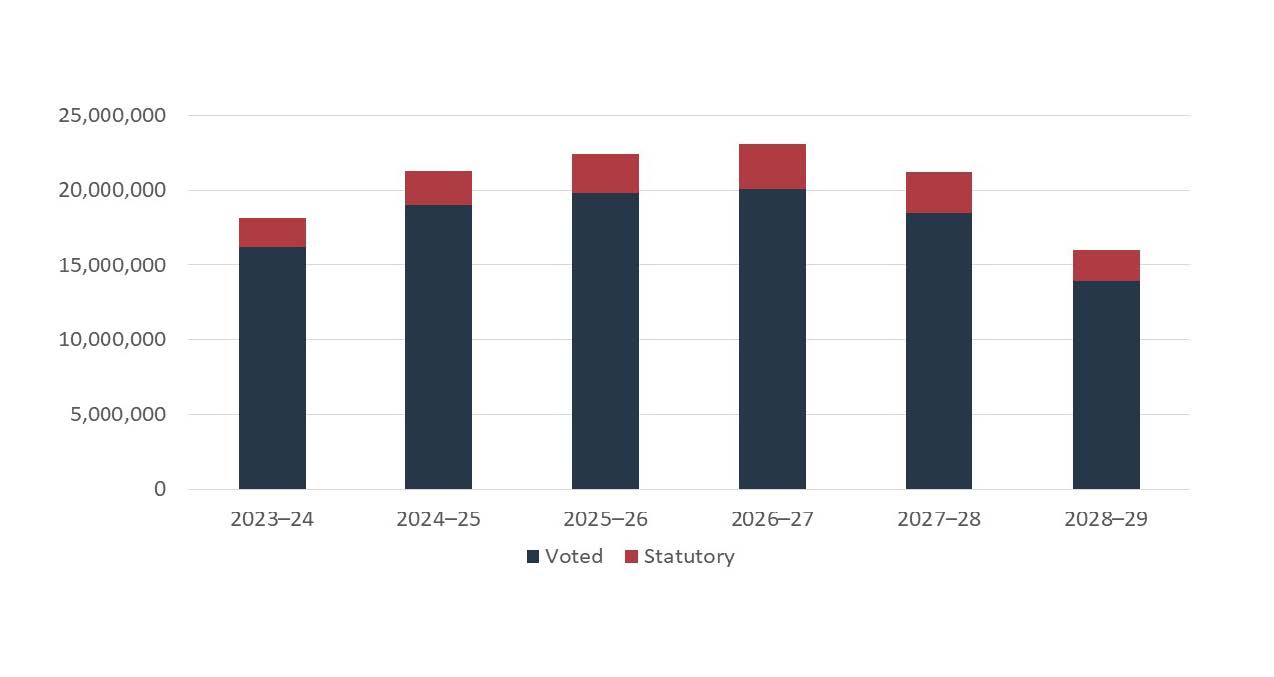
Graph 1 summarizes the department’s approved voted and statutory funding from 2023-24 to 2028-29.
Graph 1: Approved funding (statutory and voted) over a six-year period
Text description of graph 1
Graph 1 includes the following information in a bar graph:
Fiscal year | Statutory | Voted | Total |
|---|---|---|---|
2023-24 | 1,922,077 | 16,202,110 | 18,124,186 |
2024-25 | 2,219,101 | 19,041,506 | 21,260,607 |
2025-26 | 2,832,664 | 20,240,594 | 23,073,258 |
2026-27 | 2,797,043 | 19,980,242 | 22,777,285 |
2027-28 | 2,551,693 | 18,378,043 | 20,929,736 |
2028-29 | 2,051,744 | 13,910,462 | 15,962,206 |
Analysis of statutory and voted spending over a six-year period
Over the next three years (2026-27 to 2028-29), the Board’s planned spending is expected to decrease as temporary funding provided to address rising demand for review and appeal services is phased down.
Consult the Public Accounts of Canada for further information on VRAB's departmental voted and statutory expenditures.
Financial statement highlights
This section presents VRAB’s Financial statements (Unaudited) for the year ended March 31, 2026.
Table 8 summarizes the expenses and revenues for 2025-26, which net to the cost of operations before government funding and transfers.
Table 8: Condensed Statement of Operations (unaudited) for the year ended March 31, 2026 (dollars)
Financial information | 2025-26 actual results | 2025-26 planned results | Difference (actual results minus planned) |
|---|---|---|---|
Total expenses | 24,501,274 | 25,140,793 | (639,519) |
Total revenues | 0 | 0 | 0 |
Net cost of operations before government funding and transfers | 24,501,274 | 25,140,793 | (639,519) |
Analysis of expenses and revenues for 2025-26
The Board’s total operating expenses were approximately $640,000 lower than planned in the 2025-26 fiscal year.
The 2025-26 planned results information is provided in VRAB’s Future-Oriented Statement of Operations and Notes 2025-26.
Table 9 summarizes actual expenses and revenues and shows the net cost of operations before government funding and transfers.
Table 9: Condensed Statement of Operations (unaudited) for 2024-25 and 2025-26 (dollars)
Financial information | 2025-26 actual results | 2024-25 actual results | Difference (actual results minus planned) |
|---|---|---|---|
Total expenses | 24,501,274 | 23,026,046 | 1,475,228 |
Total revenues | 0 | 0 | 0 |
Net cost of operations before government funding and transfers | 24,501,274 | 23,026,046 | 1,475,228 |
Analysis of differences in expenses and revenues between 2024-25 and 2025-26
The actual expenditures of the 2025-26 fiscal year were $1.5 million higher than the previous fiscal year. This is mainly attributable to an increase in salary expenditures.
Table 10 provides a brief snapshot of the amounts the department owes or must spend (liabilities) and its available resources (assets), which helps to indicate its ability to carry out programs and services.
Table 10: Condensed Statement of Financial Position (unaudited) as at March 31, 2026 (dollars)
Financial information | Actual fiscal year (2025-26) | Previous fiscal year (2024-25) | Difference (2025-26 minus 2024-25) |
|---|---|---|---|
Total net liabilities | 2,316,256 | 2,727,498 | (411,242) |
Total net financial assets | 1,269,066 | 1,688,284 | (419,218) |
Departmental net debt | 1,047,190 | 1,039,214 | 7,976 |
Total non-financial assets | 0 | 0 | 0 |
Departmental net financial position | 1,047,190 | 1,039,214 | 7,976 |
Analysis of department’s liabilities and assets since last fiscal year
Net liabilities decreased by $411,000 thousand in 2025-26 when compared with fiscal year 2024-25. This is primarily attributable to the decrease in accrued liabilities. Net financial assets decreased by $419,000 thousand which is attributable to a decrease in the amount due from the Consolidated Revenue Fund.
Human resources
This section presents an overview of the department’s actual and planned human resources from 2023-24 to 2028-29.
Table 11 shows a summary in full-time equivalents of human resources for VRAB’s core responsibilities and for its internal services for the previous three fiscal years.
Table 11: Actual human resources for core responsibilities and internal services for the last three years
Core responsibilities and internal services | 2023-24 actual full-time equivalents | 2024-25 actual full-time equivalents | 2025-26 actual full-time equivalents |
|---|---|---|---|
Appeals | 140.4 | 169.3 | 171 |
Internal services | 05 | 05 | 05 |
Total | 140.4 | 169.3 | 171 |
5Internal Services to support the operations of the VRAB are provided at no cost under an MOU with VAC.
Analysis of human resources over the last three years
Human resources for appeals increased in 2024-25 and 2025-26 due to funding received to address increased demand for review and appeal services.
Table 12 shows the planned full-time equivalents for each of VRAB’s core responsibilities and for its internal services for the next three years. Human resources for the current fiscal year are forecast based on year to date.
Table 12: Human resources planning summary for core responsibilities and internal services for the next three years
Core responsibilities and internal services | 2026-27 planned full-time equivalents | 2027-28 planned full-time equivalents | 2028-29 planned full-time equivalents |
|---|---|---|---|
Appeals | 200 | 188 | 138 |
Internal services | 06 | 06 | 06 |
Total | 200 | 188 | 138 |
6 Internal Services to support the operations of the VRAB are provided at no cost under an MOU with VAC.
Analysis of human resources for the next three years
Planned human resources for appeals is expected to remain the same in 2026-27 for review and appeal services.
The projected decrease in human resources over the next three years reflects the gradual conclusion of temporary funding provided through Budget 2023.
Supplementary information tables
The following supplementary information tables are available on VRAB’s website:
Federal tax expenditures
The tax system can be used to achieve public policy objectives through the application of special measures such as low tax rates, exemptions, deductions, deferrals and credits. The Department of Finance Canada publishes cost estimates and projections for these measures each year in the Report on Federal Tax Expenditures. This report also provides detailed background information on tax expenditures, including descriptions, objectives, historical information and references to related federal spending programs as well as evaluations and GBA Plus of tax expenditures.
Corporate information
Departmental profile
Appropriate minister: The Honourable Jill McKnight, P.C., M.P.
Institutional head: Richard Thibault
Ministerial portfolio: Veterans Affairs
Enabling instruments: Veterans Review and Appeal Board Act; Veterans Review and Appeal Board Regulations
Year of incorporation or commencement: 1995
Other: Applications for review and appeal can be made to the Board under the following legislation:
- Pension Act;
- Veterans Well-being Act;
- War Veterans Allowance Act;
- Royal Canadian Mounted Police Pension Continuation Act; and
- Royal Canadian Mounted Police Superannuation Act.
The Board also adjudicates applications for compassionate awards made under section 34 of the Veterans Review and Appeal Board Act.
Departmental contact information
Mailing address:
Veterans Review and Appeal Board
PO Box 9900
Charlottetown, Prince Edward Island C1A 8V7
Canada
Telephone:
Toll Free in Canada and the United States
- 1-800-450-8006 (English Service) or
- 1-877-368-0859 (French Service)
From all other locations, call collect
- 0-902-566-8751 (English Service) or
- 0-902-566-8835 (French Service)
TTY: 1-833-998-2060
Fax: 1-855-850-4644
Email: info@vrab-tacra.gc.ca
Website: http://www.vrab-tacra.gc.ca
Definitions
List of terms
Appropriation (crédit)
Any authority of Parliament to pay money out of the Consolidated Revenue Fund.
Budgetary expenditures (dépenses budgétaires)
Operating and capital expenditures; transfer payments to other levels of government, departments or individuals; and payments to Crown corporations.
Core responsibility (responsabilité essentielle)
An enduring function or role of a department. The departmental results listed for a core responsibility reflect the outcomes that the department seeks to influence or achieve.
Departmental Plan (plan ministériel)
A report that outlines the anticipated activities and expected performance of an appropriated department over a three-year period. Departmental Plans are usually tabled in Parliament in spring.
Departmental priority (priorité)
A plan, project or activity that a department focuses and reports on during a specific planning period. Priorities represent the most important things to be done or those to be addressed first to help achieve the desired departmental results.
Departmental result (résultat ministériel)
A high-level outcome related to the core responsibilities of a department.
Departmental result indicator (indicateur de résultat ministériel)
A quantitative or qualitative measure that assesses progress toward a departmental result.
Departmental Results Report (rapport sur les résultats ministériels)
A framework that connects the department’s core responsibilities to its departmental results and departmental result indicators.
Departmental Results Report (rapport sur les résultats ministériels)
A report outlining a department’s accomplishments against the plans, priorities and expected results set out in the corresponding Departmental Plan.
Full-time equivalent (équivalent temps plein)
Measures the person years in a departmental budget. An employee’s scheduled hours per week divided by the employer’s hours for a full-time workweek calculates a full-time equivalent. For example, an employee who works 20 hours in a 40-hour standard workweek represents a 0.5 full-time equivalent.
Gender-based Analysis Plus (GBA Plus) (analyse comparative entre les sexes plus [ACS Plus])
An analytical tool that helps to understand the ways diverse individuals experience policies, programs and other initiatives. Applying GBA Plus to policies, programs and other initiatives helps to identify the different needs of the people affected, the ways to be more responsive and inclusive, and the methods to anticipate and mitigate potential barriers to accessing or benefitting from the initiative. GBA Plus goes beyond biological (sex) and socio-cultural (gender) differences to consider other factors, such as age, disability, education, ethnicity, economic status, geography (including rurality), language, race, religion, and sexual orientation.
Government priorities (priorités pangouvernementales)
For the purpose of the 2025-26 Departmental Results Report, government priorities are the high-level themes outlining the government’s agenda as announced in the 2025 Speech from the Throne.
Horizontal initiative (initiative horizontale)
A program, project or other initiative where two or more federal departments receive funding to work collaboratively on a shared outcome usually linked to a government priority, and where the ministers involved agree to designate it as horizontal. Specific reporting requirements apply, including that the lead department must report on combined expenditures and results.
Indigenous business (entreprise autochtones)
Requirements for verifying Indigenous businesses for the purposes of the departmental result report are available through the Indigenous Services Canada Mandatory minimum 5% Indigenous procurement target website.
Non-budgetary expenditures (dépenses non budgétaires)
Net outlays and receipts related to loans, investments and advances, which change the composition of the financial assets of the Government of Canada.
Performance (rendement)
What a department did with its resources to achieve its results, how well those results compare to what the department intended to achieve, and how well lessons learned have been identified.
Performance indicator (indicateur de rendement)
A qualitative or quantitative measure that assesses progress toward a departmental-level or program-level result, or the expected outputs or outcomes of a program, policy or initiative.
Plan (plan)
The articulation of strategic choices, which provides information on how a department intends to achieve its priorities and associated results. Generally, a plan will explain the logic behind the strategies chosen and tend to focus on actions that lead to the expected result.
Planned spending (dépenses prévues)
For Departmental Plans and Departmental Results Reports, planned spending refers to the amounts presented in Main Estimates. Departments must determine their planned spending and be able to defend the financial numbers presented in their Departmental Plans and Departmental Results Reports.
Program (programme)
An Individual, group, or combination of services and activities managed together within a department and focused on a specific set of outputs, outcomes or service levels.
Program inventory (répertoire des programmes)
A listing that identifies all the department’s programs and the resources that contribute to delivering on the department’s core responsibilities and achieving its results.
Result (résultat)
An outcome or output related to the activities of a department, policy, program or initiative.
Statutory expenditures (dépenses législatives)
Spending approved through legislation passed in Parliament, other than appropriation acts. The legislation sets out the purpose and the terms and conditions of the expenditures.
Target (cible)
A quantitative or qualitative, measurable goal that a department, program or initiative plans to achieve within a specified time period.
Voted expenditures (dépenses votées)
Spending approved annually through an appropriation act passed in Parliament. The vote also outlines the conditions that govern the spending.